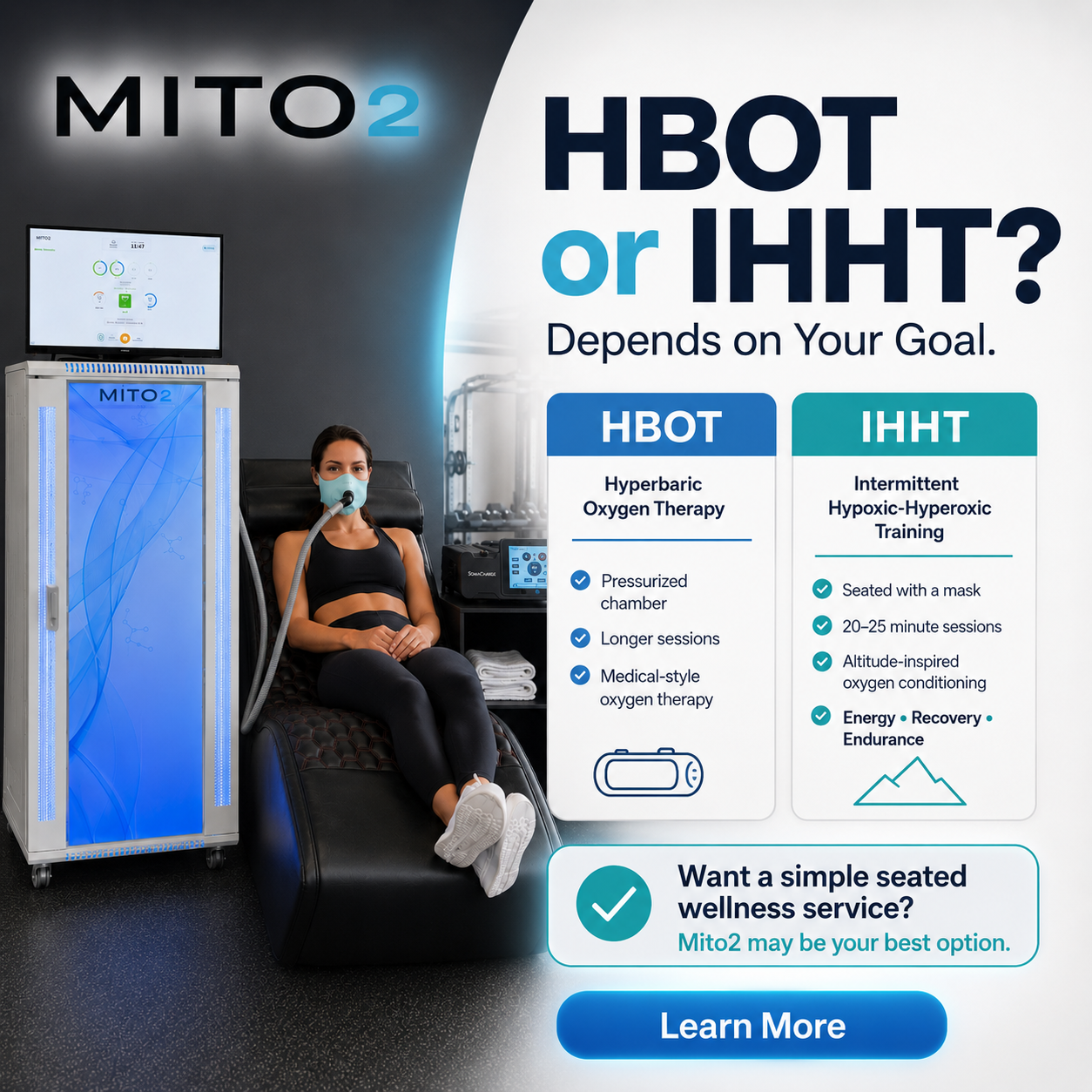
The Short Version
- Hyperbaric is a passive oxygen experience: the client rests in a chamber while oxygen is delivered under pressure.
- IHHT is active cellular training: alternating lower-oxygen and higher-oxygen air at normal room pressure gives cells something to respond to, session after session.
- Of the two, IHHT is the more versatile facility service. Shorter sessions, a smaller footprint, staff monitoring, and five training modes let one system serve performance, recovery, and general wellness clients.
- Hyperbaric still has a real place. If the chamber experience itself is what your clients are asking for, it fits.
- The oxygen-sensing biology behind IHHT (the HIF pathway) earned the 2019 Nobel Prize in Physiology or Medicine [6].
Hyperbaric Oxygen or Altitude-Inspired Training?
Most clients already recognize the words "hyperbaric oxygen." They have seen the chamber on a podcast, in a locker room, or in a recovery studio. Very few of them have heard "intermittent hypoxic-hyperoxic training," but nearly all of them understand the idea the moment you say "altitude training." Athletes train at altitude to come back stronger. That is the mental shortcut people already have.
So here is the honest framing. Hyperbaric is the more familiar name. Altitude-inspired training is the more familiar idea. IHHT delivers that altitude-style stimulus indoors, in minutes, at normal room pressure, with staff watching the numbers the whole time.
The question is not which one sounds more impressive. It is which one fits your space, your workflow, your clients, and your business model. Both are real experiences. They simply require different rooms, different scheduling, and different conversations at the front desk.
What Is the Difference?
| HBOTHyperbaric Oxygen Therapy | IHHTIntermittent Hypoxic-Hyperoxic Training |
|---|
| Experience | Passive oxygen experience under pressure | Active Cellular Training through changing oxygen levels |
| Setup | Chamber-based | Seated in a lounger, or active on a bike, with a mask |
| Air the client breathes | Oxygen at increased barometric pressure | Lower oxygen percentage (about 11 to 15%), then enriched oxygen, at normal pressure |
| Space and workflow | Dedicated room, workflow, and session planning | Smaller footprint that can fit existing rooms |
| Monitoring | Session planning around the chamber | Staff-monitored sessions with real-time SpO₂ tracking |
| Typical fit | Often chosen when the chamber experience is the main draw | Chiropractic, wellness, recovery, med-spa, and performance facilities |
| Why owners look at it | Immersive, longer sessions | Space, scheduling flexibility, and service flow |
The Science in Plain English
Think about it this way: hyperbaric is about delivering oxygen under pressure. IHHT is about teaching the body to respond to changing oxygen levels. That is why Mito2 calls it Active Cellular Training.
Cells sense oxygen through a family of signals called hypoxia-inducible factors. The discovery of how that sensing works won the 2019 Nobel Prize in Physiology or Medicine [6]. In plain terms:
- HIF-1 alpha is the faster signal tied to how cells adjust their energy handling when oxygen changes.
- HIF-2 alpha is the signal most closely linked to erythropoietin (EPO), which supports red blood cell production [4].
- Think signal now, construction later. The signal happens during the session. The slower adaptations build over a program of sessions.
Mito2 creates that stimulus by lowering the oxygen concentration in the air while barometric pressure stays normal, which produces a controlled, altitude-like challenge rather than a copy of being at altitude.
Want the phase-by-phase version? See how a Mito2 session works and what a session feels like.
What the Research Looks At
Published studies on intermittent hypoxic-hyperoxic exposure are mostly small and focused on older adults, and they study protocols and populations rather than any specific device:
- A randomized controlled trial paired the exposure with a multimodal training program and measured mobility and perceived health outcomes [3].
- An earlier trial looked at cognitive performance measures in geriatric patients [2].
- A 2022 randomized trial applied the exposure before aerobic cycling and measured physical and cognitive performance [1].
- A 2026 randomized clinical trial followed a six-week program in older adults, tracking blood pressure, respiratory function, and autonomic measures [5].
Read the studies yourself before you talk about them with clients. Mito2 is a wellness system, not a treatment, and nothing here is a promise of a clinical outcome.
What Facilities Use IHHT For
Facilities often use IHHT to support programs built around:
- Performance and endurance-focused services
- Recovery and reconditioning programs
- Oxygen-efficiency and breathing-focused training
- General wellness and resilience support
- Differentiated cash-pay or membership-based services
- A monitored, repeatable experience that can encourage rebooking
Why Facility Owners Pay Attention
- Versatility across multiple client types
- Shorter session times can improve scheduling flexibility
- Smaller footprint can make implementation easier
- Staff-operated and monitored workflow
- Can stack onto services you already offer
- Built to be a professional facility service, not a home product
Want to Estimate What It Could Mean for Your Business?
Use the three-step Revenue-Ready calculator:
- Capacity Planner. See how many sessions your space and hours realistically support.
- See Your Potential. Model what that session volume could look like.
- Stack It On What You Already Offer. See how IHHT fits alongside your current services.
Here Is the Takeaway
Hyperbaric and IHHT are not the same, and that is the point. Hyperbaric is passive: the client rests while oxygen is delivered. IHHT is active: changing oxygen levels give cells something to respond to, which is why Mito2 calls it Active Cellular Training.
If a chamber-based oxygen experience is exactly what your clients are asking for, hyperbaric may fit. But if you want the more versatile service, the one that can serve performance clients, recovery clients, and general wellness clients out of the same room with shorter, staff-monitored sessions, IHHT is the one that does the training. Mito2 deserves a closer look.
You can also compare the Mito2 IHHT machine, review the complete facility package, or browse the research library.
References
- Behrendt T, et al. Effects of intermittent hypoxia-hyperoxia exposure prior to aerobic cycling exercise on physical and cognitive performance in geriatric patients: a randomized controlled trial. Frontiers in Physiology, 2022.
- Bayer U, et al. Intermittent hypoxic-hyperoxic training on cognitive performance in geriatric patients. Alzheimer's & Dementia: TRCI, 2017.
- Bayer U, et al. Effects of intermittent hypoxia-hyperoxia on mobility and perceived health in geriatric patients performing a multimodal training intervention: a randomized controlled trial. BMC Geriatrics, 2019.
- Semenza GL. Regulation of erythropoiesis by the hypoxia-inducible factor pathway. Annual Review of Medicine.
- Ladriñán-Maestro A, et al. Effects of a 6-week intermittent hypoxia-hyperoxia exposure program in older adults: a randomized clinical trial. Sports, 2026.
- The Nobel Assembly. How cells sense and adapt to oxygen availability: scientific background, 2019 Nobel Prize in Physiology or Medicine.
Mito2 is a wellness system and is not intended to diagnose, treat, cure, or prevent disease. Session protocols are determined by the supervising professional.